Skip to main contentSkip to footer
  • 110% Diamond Upgrade
  • Low Price Guarantee
  • Lifetime Service & Maintenance
  • Financing & Layaway
  • (919) 725-3444
  • Make an AppointmentWalk-ins Welcome
  • Toggle My Account Menu
    Login
    Forgot Password?

    Don’t have an account? Sign up now

  • Toggle My Wishlist
  • Toggle Shopping Cart Menu
Raleigh Diamond Fine Jewelry logo
  • Engagement Rings
    Build a Ring
    SolitaireHaloThree StoneVintageSide StonePavéChannelMulti RowStart with a SettingStart with a Natural DiamondStart with a Lab Grown Diamond
    In-Stock Rings
    Complete Engagement RingsRing Settings for Your Stone(s)View All Rings
    Custom Engagement Rings
    Diamond Consultations
    Bridal Consultation
    110% Diamond Upgrade
  • Wedding Bands
    Ladies Wedding Bands
    Ladies Diamond Wedding BandsLadies Gold Wedding Bands
    Men's Wedding Bands
    Men's Wedding BandsAlternative Wedding Bands
    Custom Wedding Bands
    Wedding Band Builder
    Menu image
    Menu image
    Menu image
  • Diamonds
    Build Your Ring
    Start with a SettingStart with a Lab Grown DiamondStart with a Natural Diamonds
    Why Choose Us?
    Natural Diamonds
    Round The beloved round diamond, with its 58 dazzling facets, was perfected in 1919 and is now the most popular diamond shape in the world. Its journey began in the 1700s with the 'Old Mine Cut,' which closely resembled a cushion shape. Today, the round brilliant cut is synonymous with everlasting love and timeless sophistication. Princess The princess cut diamond is a modern marvel with roots in the 14th-century French cut. Perfected in the 1960s and skyrocketing in popularity by the 1980s, it's celebrated for its clean, sharp points and ability to use up to 80% of the rough diamond. This cut is bold, contemporary, and effortlessly chic. Emerald The Emerald Cut, also called the 'Step Cut,' is a masterpiece of symmetry and sophistication. Originally crafted for emerald gemstones over 600 years ago, this cut was designed to prevent chipping, making it as practical as it is beautiful. Its elongated, mirror-like facets create a 'hall of mirrors' effect that exudes vintage glamour and modern refinement. Oval The oval diamond's origins date back to the 1300s, but its modern elegance was perfected in 1957 by the renowned Chicago diamond cutter Lazare Kaplan. Known as the 'Oval Brilliant,' this shape delivers a legacy of grace and brilliance, cherished for its ability to elongate and flatter the wearer's hand. Cushion The cushion cut, originally crafted in the late 1700s as the Old Mine Cut, has gracefully evolved into the modern masterpiece we adore today. With its soft, rounded edges and sparkling facets, this shape captures the essence of timeless romance. Its very name evokes the image of a luxurious, glittering pillow, making it a symbol of comfort and enduring beauty. Radiant First crafted in 1977 by Henry Grossbard, the Radiant cut is a marvel of brilliance with its 70 intricate facets. Designed to maximize sparkle while concealing imperfections, this shape is as practical as it is breathtaking. The Radiant cut is perfect for those who seek brilliance with a contemporary edge. Pear Romantically known as the 'Tear Drop,' the pear-shaped diamond combines timeless grace with a touch of individuality. Perfected in 1475 by a Flemish diamond cutter who revolutionized diamond polishing, this iconic shape remains a symbol of elegance and precision to this day. Heart As a universal symbol of love, the heart-shaped diamond has been cherished since 1463. Mary Queen of Scots famously gifted a heart-shaped diamond ring to Queen Elizabeth I, solidifying its place in history. A heart-shaped diamond is the ultimate expression of romance, passion, and devotion. Marquise Fit for royalty, the Marquise cut was commissioned by King Louis XV to mimic the shape of his lover's lips. With its elongated, pointed silhouette, this shape exudes romance and opulence. Popularized again in modern times by celebrities like Selena Gomez, the Marquise cut is a true conversation starter. Asscher Created in 1902 by Joseph Asscher, the Asscher cut is a work of art with its distinctive X-shaped pattern and step cuts. Often called the 'Hall of Mirrors,' it captures light in mesmerizing ways. Made famous by Elizabeth Taylor's dazzling Asscher-cut diamond from Richard Burton, this shape is a symbol of classic Hollywood glamour.
    Lab Grown Diamonds
    Round The beloved round diamond, with its 58 dazzling facets, was perfected in 1919 and is now the most popular diamond shape in the world. Its journey began in the 1700s with the 'Old Mine Cut,' which closely resembled a cushion shape. Today, the round brilliant cut is synonymous with everlasting love and timeless sophistication. Princess The princess cut diamond is a modern marvel with roots in the 14th-century French cut. Perfected in the 1960s and skyrocketing in popularity by the 1980s, it's celebrated for its clean, sharp points and ability to use up to 80% of the rough diamond. This cut is bold, contemporary, and effortlessly chic. Emerald The Emerald Cut, also called the 'Step Cut,' is a masterpiece of symmetry and sophistication. Originally crafted for emerald gemstones over 600 years ago, this cut was designed to prevent chipping, making it as practical as it is beautiful. Its elongated, mirror-like facets create a 'hall of mirrors' effect that exudes vintage glamour and modern refinement. Oval The oval diamond's origins date back to the 1300s, but its modern elegance was perfected in 1957 by the renowned Chicago diamond cutter Lazare Kaplan. Known as the 'Oval Brilliant,' this shape delivers a legacy of grace and brilliance, cherished for its ability to elongate and flatter the wearer's hand. Cushion The cushion cut, originally crafted in the late 1700s as the Old Mine Cut, has gracefully evolved into the modern masterpiece we adore today. With its soft, rounded edges and sparkling facets, this shape captures the essence of timeless romance. Its very name evokes the image of a luxurious, glittering pillow, making it a symbol of comfort and enduring beauty. Radiant First crafted in 1977 by Henry Grossbard, the Radiant cut is a marvel of brilliance with its 70 intricate facets. Designed to maximize sparkle while concealing imperfections, this shape is as practical as it is breathtaking. The Radiant cut is perfect for those who seek brilliance with a contemporary edge. Pear Romantically known as the 'Tear Drop,' the pear-shaped diamond combines timeless grace with a touch of individuality. Perfected in 1475 by a Flemish diamond cutter who revolutionized diamond polishing, this iconic shape remains a symbol of elegance and precision to this day. Heart As a universal symbol of love, the heart-shaped diamond has been cherished since 1463. Mary Queen of Scots famously gifted a heart-shaped diamond ring to Queen Elizabeth I, solidifying its place in history. A heart-shaped diamond is the ultimate expression of romance, passion, and devotion. Marquise Fit for royalty, the Marquise cut was commissioned by King Louis XV to mimic the shape of his lover's lips. With its elongated, pointed silhouette, this shape exudes romance and opulence. Popularized again in modern times by celebrities like Selena Gomez, the Marquise cut is a true conversation starter. Asscher Created in 1902 by Joseph Asscher, the Asscher cut is a work of art with its distinctive X-shaped pattern and step cuts. Often called the 'Hall of Mirrors,' it captures light in mesmerizing ways. Made famous by Elizabeth Taylor's dazzling Asscher-cut diamond from Richard Burton, this shape is a symbol of classic Hollywood glamour.
    Menu image
  • Fine Jewelry
    New Arrivals
    Jewelry by Category
    Engagement RingsSemi-MountsWedding BandsEarringsNecklacesChainsFashion RingsBraceletsCharms & PendantsMen's JewelryEstate JewelryEngravable Jewelry
    Must Have Styles
    StudsHoopsStatement EarringsDrop & Dangle EarringsTennis BraceletsBangle BraceletsChain Bracelets
    Diamond Jewelry
    RingsEarringsNecklacesCharms & PendantsBracelets
    Colored Stone Jewelry
    BirthstonesEarringsNecklacesFashion RingsBraceletsCharms & PendantsPearls
    Gold Jewelry
    EarringsNecklacesFashion RingsBraceletsCharms & Pendants
    Silver Jewelry
    EarringsNecklacesFashion RingsBraceletsCharms & Pendants
    Watches
    Watches & BraceletsPre-Owned Designer Timepieces
    Your Also May Be Interested In
    Jewelry Boxes & AccessoriesCufflinksGift Ideas Under $500
    Menu image
  • Designers
    Engagement Rings
    Ever & EverGabriel & Co.JewelexRaleigh DiamondS. Kashi & SonsStullerTiffany & Co. Estate
    Wedding Bands
    BenchmarkGabriel & Co.S. Kashi & SonsStuller
    Fashion Jewelry
    JewelexAnia HaieAurelie GiGabriel & Co.Heera MotiImperial PearlsStuller
    Estate Designers
    CartierDavid YurmanJohn HardyRolexTiffany & Co.Van Cleef & Arpels
    Menu image
    Menu image
  • Financing
  • Education
  • About Us
    About Us
    Why Choose Raleigh DiamondMeet the TeamStore ReviewsCharities We Support
    Contact Us
    Schedule an AppointmentSend Us a Message
    Follow Us
    On Social MediaView Our Blog
    Menu image
  • 110% Diamond Upgrade
  • Low Price Guarantee
  • Lifetime Service & Maintenance
  • Financing & Layaway
Raleigh Diamond Fine Jewelry logo
Log In My Cart

OCTOBER

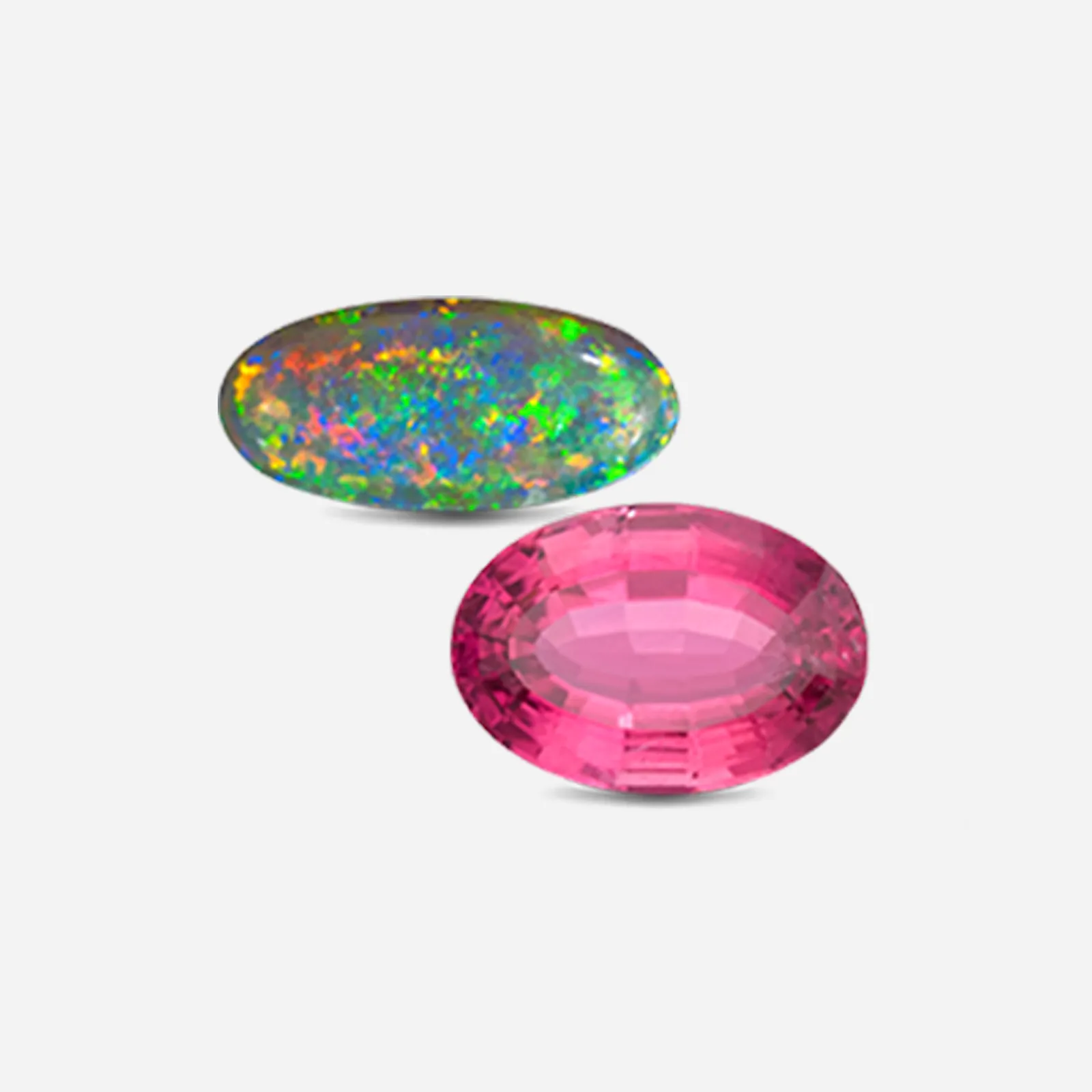
The birthstones for this month are opal and tourmaline

Raleigh Diamond Fine Jewelry Raleigh, NC

BIRTHSTONES OVERVIEW


Opal and tourmaline are the two birthstones for October. Both of these gemstones are known for their endless color combinations and are believed to have been created from rainbows. Learn more about these two birthstones for October and discover their meanings and where they can be found.

Those born in October enjoy two spectacular birthstones to commemorate their birthdays – opal and tourmaline. Both October birthstones have endless color combinations and beautiful coloring characteristics. Learn more about these two October birthstones and discover the perfect gift for those born in the tenth month.

OPAL BIRTHSTONE MEANING & HISTORY

The name of this, the traditional October birthstone, is believed to have originated in India (the source of the first opals brought to the Western world), where in Sanskrit it was called upala, a “precious stone." .” In ancient Rome, this became opalus. Most opals are valued for their shifting colors in rainbow hues – a phenomenon known as “play-of-color.”The October birthstone’s dramatic play-of-color has inspired writers to compare it to fireworks, galaxies and volcanoes. Bedouins once believed opal held lightning and fell from the sky during thunderstorms. Ancient Greeks thought opals bestowed the gift of prophesy and protection from disease. Europeans long maintained opal to be a symbol of purity, hope and truth. Hundreds of years ago, opal was believed to embody the virtues and powers of all colored stones.Opal is also the stone given to celebrate the 14th wedding anniversary.

WHERE IS OPAL FOUND?

The opal birthstone can be found in many places. The fields of Australia are the most productive in the world for the October birthstone. Ethiopia, Mexico and Brazil are also important sources. Additional deposits have been found in Central Europe, Honduras, Indonesia, Madagascar, Peru, Turkey and the United States.Lightning Ridge, a small town in New South Wales, Australia, is famed for producing prized black opal. A dry and rocky region softened only by small trees and scrub brush, Lightning Ridge gets little rain and bakes in the scorching summer temperatures. The climate is so unforgiving that miners often live underground to find respite from the punishing heat. Australia is also a source of other types of the October birthstone. White opal is found in the White Cliffs area of New South Wales, as well as in Mintabie, Andamooka and Coober Pedy in South Australia. Boulder opal, which comes from only one location in the world, is mined in Queensland. In Ethiopia, the October birthstone is found near the village of Wegel Tena, in Wollo Province. Travel 340 miles (about 550 kilometers) north of the capital Addis Ababa and up 8,000 feet (2,400 meters), where miners pry opal from shafts dug into the side of a plateau. Gems unearthed here range in body color from white, yellow, orange and brownish red to “chocolate” brown. Some of the opals show play-of-color. Another mine, in Ethiopia’s Shewa Province, yields the coveted black opal, as well as orange, white and crystal opal. Its treasures are buried in steep cliffs that tower over the landscape. Querétero, a state in Mexico, is known for producing fire opal in yellow, orange and reddish orange to red, some with good play-of-color. The mines are a tourist destination, and getting to them requires taking a dirt road through dense forests of pine and oak, past scrubby plateaus of cacti and shrubs, and up winding mountain roads.

OPAL BIRTHSTONE CARE & CLEANING

Opal may be treated by impregnation with oil, wax or plastic. Opal doublets or triplets are fine slices of opal glued to a base material and covered with a thin dome of clear quartz. The safest way to clean this October birthstone is with warm, soapy water. Other cleaning methods might damage the opal or filler material. Note that prolonged exposure to water may weaken the adhesive in opal doublets and triplets. Even natural opal can fracture if exposed to high heat or sudden temperature changes.This October birthstone ranges from 5 to 6.5 on the Mohs scale of hardness. To prevent jewelry set with harder gems from scratching opal, store it by itself. Diamonds, rubies, sapphires, and emeralds are just a few of the gems that can scratch the October birthstone.

TOURMALINE BIRTHSTONE MEANING & HISTORY

Tourmaline is the newer October birthstone. The name comes from the Sinhalese word toramalli, which means “stone with mixed colors,” because it often has multiple colors in one crystal. Very few gems match tourmaline’s dazzling array of colors. Perhaps this is why ancient mystics believed this October birthstone could inspire artistic expression – it has a color palette for every mood. Among the most popular are the pink and red rubellites, the emerald green “chrome” tourmalines, and the neon green and blue-to-violet “paraíba” tourmalines. Because of its vast range of colors, tourmaline was often mistaken for other gemstones One of the “rubies” in the Russian crown jewels, the “Caesar’s Ruby” pendant, is actually red (rubellite) tourmaline. A Spanish conquistador found green tourmaline crystals in Brazil in the 1500s and confused the stones with emerald. These and other cases of mistaken identity continued for centuries until scientists recognized tourmaline as a distinct mineral species in the 1800s. Different colors of tourmaline are thought to have their own healing properties. Black tourmaline is believed to protect the wearer and give a sense of self-confidence. Pink tourmaline embodies love and is associated with compassion and gentleness. Green tourmaline promotes courage, strength and stamina. Tourmaline is given to celebrate the eighth wedding anniversary.

WHERE IS TOURMALINE FOUND?

This October birthstone is most commonly found in Brazil, but it is also mined in Afghanistan, Pakistan, Kenya, Madagascar and Mozambique (among other countries in Africa). California and Maine are historically important producers of fine tourmaline in the United States. Most of the tourmaline mined in Brazil over the centuries comes from pegmatites in the state of Minas Gerais. These subterranean intrusions of magma are the source of a virtual kaleidoscope of gem minerals. In the late 1980s, however, electric green, blue and violet tourmalines entered the gem market from pegmatites in Brazil’s Paraíba State. Scientists found that the intense colors were caused by trace amounts of copper, which had previously not been recorded as a coloring agent in any other tourmaline. In the early 2000s, Paraíba-type copper-bearing tourmalines were also discovered in Mozambique and Nigeria. Overall, prices for the best Paraíba and Paraíba-type tourmalines easily surpass other tourmalines due to their vivid hues, higher color saturation and greater rarity. In the United States, both Southern California and Maine host several pegmatite districts. For more than a century, they have sporadically yielded large quantities of tourmaline. Maine’s first major tourmaline deposit was discovered in 1820 at Mount Mica in Paris, by two young boys exploring the local area. Even today, a quarry at Mount Mica intermittently produces various colors of gem tourmaline. The Dunton mine, near Plumbago Mountain, is the most prolific producer of tourmaline in Maine. In 1898, California’s first commercial tourmaline mine opened at the Himalaya pegmatite in the Mesa Grande district – famed for the production of fine rubellite. To feed Empress Dowager Cixi’s obsession with the vibrant color, San Diego mines sent 120 tons of gem rubellite to Imperial China between 1902 and 1910. With the death of Cixi in 1908 and the subsequent overthrow of the Qing dynasty, the heyday of tourmaline mining in California ended. Today, only a few mines in San Diego County occasionally produce gem-quality tourmaline.

TOURMALINE BIRTHSTONE CARE & CLEANING

The tourmaline birthstone is rated 7 to 7.5 on the Mohs scale of hardness and is generally suitable for everyday wear. These colorful gems are usually stable enough to withstand light and most chemicals, but heat can be damaging. This October birthstone is best cleaned with warm, soapy water and a soft brush The use of ultrasonic and steam cleaners is not recommended. Now that you know a little bit more about the history of these two October birthstones and where they can be found, you just might be inspired to add them to your collection!

Raleigh Diamond Fine Jewelry
5925 Glenwood Avenue, Suite 100
Raleigh, NC 27612
(919) 725-3444
Store Information
Hours
Mon-Sat:Monday - Saturday:
10:00am - 7:00pm
Sunday:
12:00pm - 6:00pm
Follow Us
MAKE AN APPOINTMENT
Shop Jewelry
  • Engagement Rings
  • Gemstones
  • Wedding Bands
  • Ladies Wedding Bands
  • Fashion Rings
  • Earrings
  • Bracelets
  • Chains
  • Necklaces
  • Charms & Pendants
  • Mens Jewelry
  • Birthstones
  • Cufflinks
  • Watches
  • Designer Jewelry
  • Estate Jewelry
  • Estate Designer Jewelry
  • Accessories
  • Engravable Jewelry
  • Gifts ideas under 500
Our Store
  • About Us
  • Why Choose Raleigh Diamond
  • Store Reviews
  • Charities We Support
  • Meet the Team
  • Contact Us
Customer Service
  • Services
  • Shipping Policy
  • Warranties & Guarantees
  • Lifetime Service & Maintenance
  • Military & Service Discount
  • Return Policy
  • Privacy Policy
  • Terms & Conditions
  • My Account
  • Return Policy
  • Privacy Policy
  • Terms & Conditions
  • Accessibility Statement

© 2026 Raleigh Diamond Fine Jewelry. All Rights Reserved.

Powered by: Punchmark

My Bag
Shopping cart contents
Loading

Learn how we use cookies in our Privacy Policy or manage cookie preferences.