Skip to main contentSkip to footer
  • 110% Diamond Upgrade
  • Low Price Guarantee
  • Lifetime Service & Maintenance
  • Financing & Layaway
  • (919) 725-3444
  • Make an AppointmentWalk-ins Welcome
  • Toggle My Account Menu
    Login
    Forgot Password?

    Don’t have an account? Sign up now

  • Toggle My Wishlist
  • Toggle Shopping Cart Menu
Raleigh Diamond Fine Jewelry logo
  • Engagement Rings
    Build a Ring
    SolitaireHaloThree StoneVintageSide StonePavéChannelMulti RowStart with a SettingStart with a Natural DiamondStart with a Lab Grown Diamond
    In-Stock Rings
    Complete Engagement RingsRing Settings for Your Stone(s)View All Rings
    Custom Engagement Rings
    Diamond Consultations
    Bridal Consultation
    110% Diamond Upgrade
  • Wedding Bands
    Ladies Wedding Bands
    Ladies Diamond Wedding BandsLadies Gold Wedding Bands
    Men's Wedding Bands
    Men's Wedding BandsAlternative Wedding Bands
    Custom Wedding Bands
    Wedding Band Builder
    Menu image
    Menu image
    Menu image
  • Diamonds
    Build Your Ring
    Start with a SettingStart with a Lab Grown DiamondStart with a Natural Diamonds
    Why Choose Us?
    Natural Diamonds
    Round The beloved round diamond, with its 58 dazzling facets, was perfected in 1919 and is now the most popular diamond shape in the world. Its journey began in the 1700s with the 'Old Mine Cut,' which closely resembled a cushion shape. Today, the round brilliant cut is synonymous with everlasting love and timeless sophistication. Princess The princess cut diamond is a modern marvel with roots in the 14th-century French cut. Perfected in the 1960s and skyrocketing in popularity by the 1980s, it's celebrated for its clean, sharp points and ability to use up to 80% of the rough diamond. This cut is bold, contemporary, and effortlessly chic. Emerald The Emerald Cut, also called the 'Step Cut,' is a masterpiece of symmetry and sophistication. Originally crafted for emerald gemstones over 600 years ago, this cut was designed to prevent chipping, making it as practical as it is beautiful. Its elongated, mirror-like facets create a 'hall of mirrors' effect that exudes vintage glamour and modern refinement. Oval The oval diamond's origins date back to the 1300s, but its modern elegance was perfected in 1957 by the renowned Chicago diamond cutter Lazare Kaplan. Known as the 'Oval Brilliant,' this shape delivers a legacy of grace and brilliance, cherished for its ability to elongate and flatter the wearer's hand. Cushion The cushion cut, originally crafted in the late 1700s as the Old Mine Cut, has gracefully evolved into the modern masterpiece we adore today. With its soft, rounded edges and sparkling facets, this shape captures the essence of timeless romance. Its very name evokes the image of a luxurious, glittering pillow, making it a symbol of comfort and enduring beauty. Radiant First crafted in 1977 by Henry Grossbard, the Radiant cut is a marvel of brilliance with its 70 intricate facets. Designed to maximize sparkle while concealing imperfections, this shape is as practical as it is breathtaking. The Radiant cut is perfect for those who seek brilliance with a contemporary edge. Pear Romantically known as the 'Tear Drop,' the pear-shaped diamond combines timeless grace with a touch of individuality. Perfected in 1475 by a Flemish diamond cutter who revolutionized diamond polishing, this iconic shape remains a symbol of elegance and precision to this day. Heart As a universal symbol of love, the heart-shaped diamond has been cherished since 1463. Mary Queen of Scots famously gifted a heart-shaped diamond ring to Queen Elizabeth I, solidifying its place in history. A heart-shaped diamond is the ultimate expression of romance, passion, and devotion. Marquise Fit for royalty, the Marquise cut was commissioned by King Louis XV to mimic the shape of his lover's lips. With its elongated, pointed silhouette, this shape exudes romance and opulence. Popularized again in modern times by celebrities like Selena Gomez, the Marquise cut is a true conversation starter. Asscher Created in 1902 by Joseph Asscher, the Asscher cut is a work of art with its distinctive X-shaped pattern and step cuts. Often called the 'Hall of Mirrors,' it captures light in mesmerizing ways. Made famous by Elizabeth Taylor's dazzling Asscher-cut diamond from Richard Burton, this shape is a symbol of classic Hollywood glamour.
    Lab Grown Diamonds
    Round The beloved round diamond, with its 58 dazzling facets, was perfected in 1919 and is now the most popular diamond shape in the world. Its journey began in the 1700s with the 'Old Mine Cut,' which closely resembled a cushion shape. Today, the round brilliant cut is synonymous with everlasting love and timeless sophistication. Princess The princess cut diamond is a modern marvel with roots in the 14th-century French cut. Perfected in the 1960s and skyrocketing in popularity by the 1980s, it's celebrated for its clean, sharp points and ability to use up to 80% of the rough diamond. This cut is bold, contemporary, and effortlessly chic. Emerald The Emerald Cut, also called the 'Step Cut,' is a masterpiece of symmetry and sophistication. Originally crafted for emerald gemstones over 600 years ago, this cut was designed to prevent chipping, making it as practical as it is beautiful. Its elongated, mirror-like facets create a 'hall of mirrors' effect that exudes vintage glamour and modern refinement. Oval The oval diamond's origins date back to the 1300s, but its modern elegance was perfected in 1957 by the renowned Chicago diamond cutter Lazare Kaplan. Known as the 'Oval Brilliant,' this shape delivers a legacy of grace and brilliance, cherished for its ability to elongate and flatter the wearer's hand. Cushion The cushion cut, originally crafted in the late 1700s as the Old Mine Cut, has gracefully evolved into the modern masterpiece we adore today. With its soft, rounded edges and sparkling facets, this shape captures the essence of timeless romance. Its very name evokes the image of a luxurious, glittering pillow, making it a symbol of comfort and enduring beauty. Radiant First crafted in 1977 by Henry Grossbard, the Radiant cut is a marvel of brilliance with its 70 intricate facets. Designed to maximize sparkle while concealing imperfections, this shape is as practical as it is breathtaking. The Radiant cut is perfect for those who seek brilliance with a contemporary edge. Pear Romantically known as the 'Tear Drop,' the pear-shaped diamond combines timeless grace with a touch of individuality. Perfected in 1475 by a Flemish diamond cutter who revolutionized diamond polishing, this iconic shape remains a symbol of elegance and precision to this day. Heart As a universal symbol of love, the heart-shaped diamond has been cherished since 1463. Mary Queen of Scots famously gifted a heart-shaped diamond ring to Queen Elizabeth I, solidifying its place in history. A heart-shaped diamond is the ultimate expression of romance, passion, and devotion. Marquise Fit for royalty, the Marquise cut was commissioned by King Louis XV to mimic the shape of his lover's lips. With its elongated, pointed silhouette, this shape exudes romance and opulence. Popularized again in modern times by celebrities like Selena Gomez, the Marquise cut is a true conversation starter. Asscher Created in 1902 by Joseph Asscher, the Asscher cut is a work of art with its distinctive X-shaped pattern and step cuts. Often called the 'Hall of Mirrors,' it captures light in mesmerizing ways. Made famous by Elizabeth Taylor's dazzling Asscher-cut diamond from Richard Burton, this shape is a symbol of classic Hollywood glamour.
    Menu image
  • Fine Jewelry
    New Arrivals
    Jewelry by Category
    Engagement RingsSemi-MountsWedding BandsEarringsNecklacesChainsFashion RingsBraceletsCharms & PendantsMen's JewelryEstate JewelryEngravable Jewelry
    Must Have Styles
    StudsHoopsStatement EarringsDrop & Dangle EarringsTennis BraceletsBangle BraceletsChain Bracelets
    Diamond Jewelry
    RingsEarringsNecklacesCharms & PendantsBracelets
    Colored Stone Jewelry
    BirthstonesEarringsNecklacesFashion RingsBraceletsCharms & PendantsPearls
    Gold Jewelry
    EarringsNecklacesFashion RingsBraceletsCharms & Pendants
    Silver Jewelry
    EarringsNecklacesFashion RingsBraceletsCharms & Pendants
    Watches
    Watches & BraceletsPre-Owned Designer Timepieces
    Your Also May Be Interested In
    Jewelry Boxes & AccessoriesCufflinksGift Ideas Under $500
    Menu image
  • Designers
    Engagement Rings
    Ever & EverGabriel & Co.JewelexRaleigh DiamondS. Kashi & SonsStullerTiffany & Co. Estate
    Wedding Bands
    BenchmarkGabriel & Co.S. Kashi & SonsStuller
    Fashion Jewelry
    JewelexAnia HaieAurelie GiGabriel & Co.Heera MotiImperial PearlsStuller
    Estate Designers
    CartierDavid YurmanJohn HardyRolexTiffany & Co.Van Cleef & Arpels
    Menu image
    Menu image
  • Financing
  • Education
  • About Us
    About Us
    Why Choose Raleigh DiamondMeet the TeamStore ReviewsCharities We Support
    Contact Us
    Schedule an AppointmentSend Us a Message
    Follow Us
    On Social MediaView Our Blog
    Menu image
  • 110% Diamond Upgrade
  • Low Price Guarantee
  • Lifetime Service & Maintenance
  • Financing & Layaway
Raleigh Diamond Fine Jewelry logo
Log In My Cart

JUNE

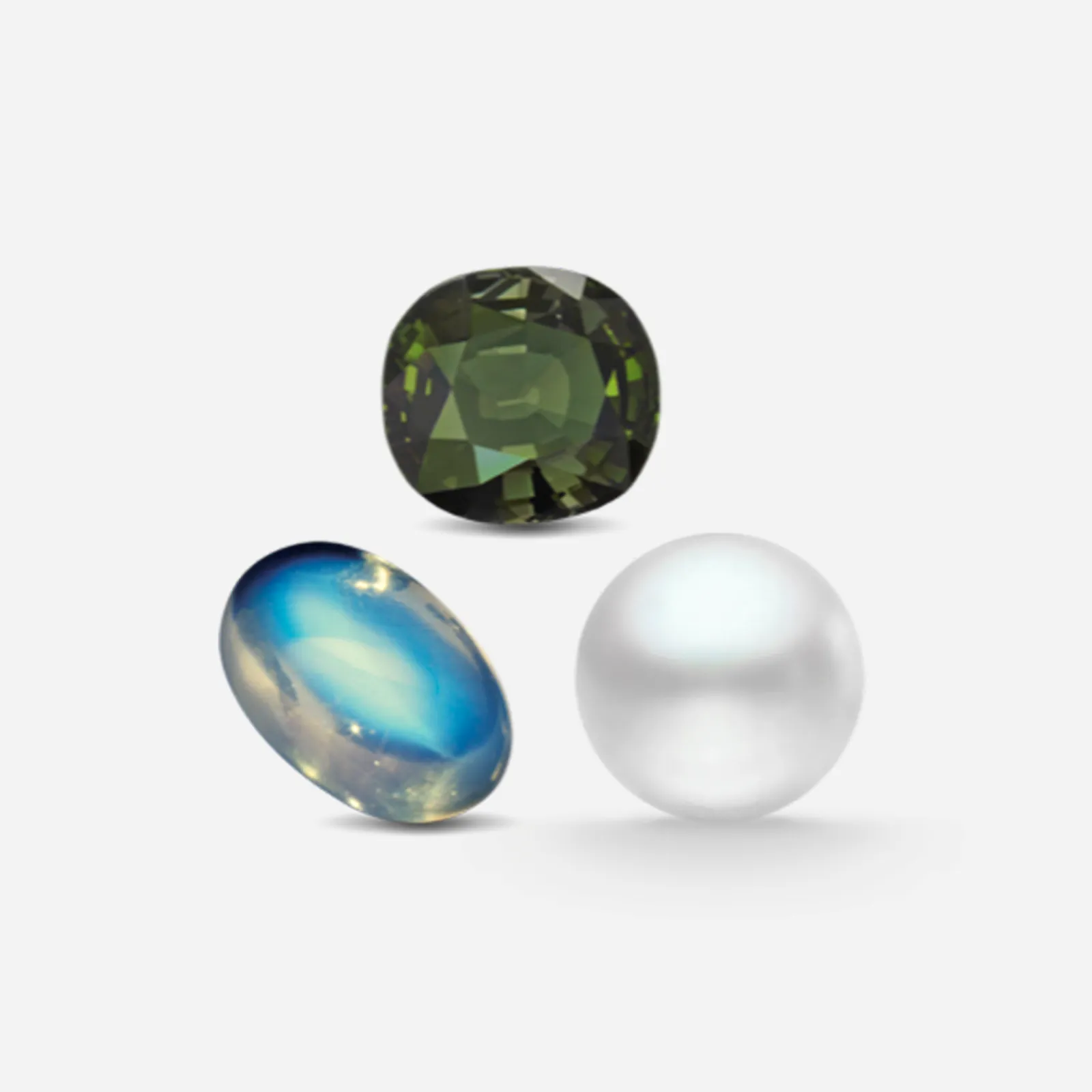
The Birthstones for this month are pearl, alexandrite and moonstone

Raleigh Diamond Fine Jewelry Raleigh, NC

BIRTHSTONES OVERVIEW


Pearl, alexandrite and moonstone are the three birthstones for June. Learn about their history and where these three June birthstones can be found, so that you can buy the perfect June birthstone for yourself or a loved one.

If you were born in the month of June, you are lucky enough to have three birthstones to call your own. June is one of only three months (the others are August and December) that has three birthstones, giving you a variety of beautiful birthstone choices. The June birthstones are pearl, alexandrite and moonstone. With so many attractive options, individuals with June birthdays can have a birthstone that fits their mood or budget, due to the different colors and price points these gems offer.

PEARL BIRTHSTONE MEANING & HISTORY

This enchanting June birthstone originates from oceans, lakes and rivers around the world. It is a timeless wardrobe staple, beloved by women of all ages. The origin of pearls fascinated our forebears. Ancients from the Middle East believed that pearls were teardrops fallen from heaven. The Chinese fancied that the June birthstone came from the brain of a dragon. Christopher Columbus and his contemporaries thought that mollusks formed pearls from dew drops.Pearls are organic gems that grow inside the tissue of a living saltwater or freshwater mollusk (either an oyster or a mussel). Natural pearls form when the mollusk secretes a substance called nacre around an irritant such as a piece of sand or a parasite that has invaded its shell. Cultured pearls are a product of human intervention. Technicians implant a piece of mantle tissue alone (common for freshwater cultured pearls) or with a mother-of-pearl shell bead (all saltwater) into a host mollusk. The mollusk covers the irritant with nacre, just like a natural pearl. Cultured pearls are raised in pearl farms – saltwater or freshwater operations where the mollusks are cleaned, protected from predators and eventually harvested. Thousands of years of pearl fishing have decimated the natural pearl beds, so cultured pearls account for the vast majority of pearl sales today. These cultured pearl birthstones come in a dazzling array of sizes, colors and shapes.Pearls have long been associated with purity, humility and innocence. So it may be said that the June birthstone meaning is "sweet simplicity." As such, pearls were traditionally given as a wedding gift.The pearl birthstone was also thought to have beneficial properties. In the ancient Sanskrit text the Atharvaveda, pearls were said to bestow long life and prosperity. In Asia, pearls were believed to help alleviate indigestion and hemorrhages. Some 19th century Arab physicians maintained that pearl powder improved eyesight, quieted nervous tremors and eased depression.One of the most famous natural pearls is the 50.56 carat (ct) La Peregrina. About the size of a pigeon’s egg, the drop shaped pearl was discovered in the 1500s in the Gulf of Panama. It became a prized possession of European royalty. Richard Burton eventually gifted it to Elizabeth Taylor in 1969; Christie’s New York auctioned the Cartier necklace containing La Peregrina for $11.8 million in 2011.

WHERE ARE PEARLS FOUND?

Warm waters… clear skies… dramatic scenery – it sounds like a dream beach vacation, don’t you think? It’s also an accurate description of where you'll often find these pearl birthstones. Pearl-bearing mollusks fail to thrive in polluted waters, so pearl farms are usually located far from civilization – and often in breathtaking settings.Saltwater cultured pearls are grown in many areas around the world. Akoya cultured pearl farms are primarily found in Japan and China, especially along the southern coasts of Guangdong and Guangxi provinces. South Sea cultured pearls are farmed from the northern coast of Australia through Indonesia to the southern coast of Southeast Asia, with large operations in the Philippines as well. The Gambier Islands and the Tuamotu Archipelago, both part of French Polynesia, are two locales where the rich black Tahitian pearls are cultured. China is the dominant source of freshwater cultured pearls. Natural pearls have been found in the Arabian Gulf (Persian Gulf) for at least 5,000 years, while divers have been recovering the June birthstone from the Red Sea since 300 BCE. The Strait of Mannar has been providing pearls since 2000 BCE. Starting in the 16th century, during Spanish colonial rule, large quantities of pearls were recovered from the waters off Mexico, Central America and what is now Venezuela. Only small quantities of pearls are found in any of these areas today.

PEARL BIRTHSTONE CARE & CLEANING

Pearls are 2.5 to 3.0 on the Mohs Scale of hardness, so they are a comparatively soft gem and require special care. Store them separately from other gemstones and metal jewelry to prevent scratching. Never store your pearl birthstones in a plastic bag — plastic can emit a chemical that will damage their surface. Always apply perfume, hair products and cosmetics before putting on your pearl jewelry. The best way to clean your June birthstone: Use a soft, damp cloth, ideally after each time the pearls are worn. Now that you know a little more about the history of pearls and where this June Birthstone comes from, you probably have a deeper appreciation for these classic beauties! If we’ve whetted your appetite for the pearl birthstone, consider adding five essential pearl jewelry pieces to your collection.

Raleigh Diamond Fine Jewelry
5925 Glenwood Avenue, Suite 100
Raleigh, NC 27612
(919) 725-3444
Store Information
Hours
Mon-Sat:Monday - Saturday:
10:00am - 7:00pm
Sunday:
12:00pm - 6:00pm
Follow Us
MAKE AN APPOINTMENT
Shop Jewelry
  • Engagement Rings
  • Gemstones
  • Wedding Bands
  • Ladies Wedding Bands
  • Fashion Rings
  • Earrings
  • Bracelets
  • Chains
  • Necklaces
  • Charms & Pendants
  • Mens Jewelry
  • Birthstones
  • Cufflinks
  • Watches
  • Designer Jewelry
  • Estate Jewelry
  • Estate Designer Jewelry
  • Accessories
  • Engravable Jewelry
  • Gifts ideas under 500
Our Store
  • About Us
  • Why Choose Raleigh Diamond
  • Store Reviews
  • Charities We Support
  • Meet the Team
  • Contact Us
Customer Service
  • Services
  • Shipping Policy
  • Warranties & Guarantees
  • Lifetime Service & Maintenance
  • Military & Service Discount
  • Return Policy
  • Privacy Policy
  • Terms & Conditions
  • My Account
  • Return Policy
  • Privacy Policy
  • Terms & Conditions
  • Accessibility Statement

© 2026 Raleigh Diamond Fine Jewelry. All Rights Reserved.

Powered by: Punchmark

My Bag
Shopping cart contents
Loading

Learn how we use cookies in our Privacy Policy or manage cookie preferences.